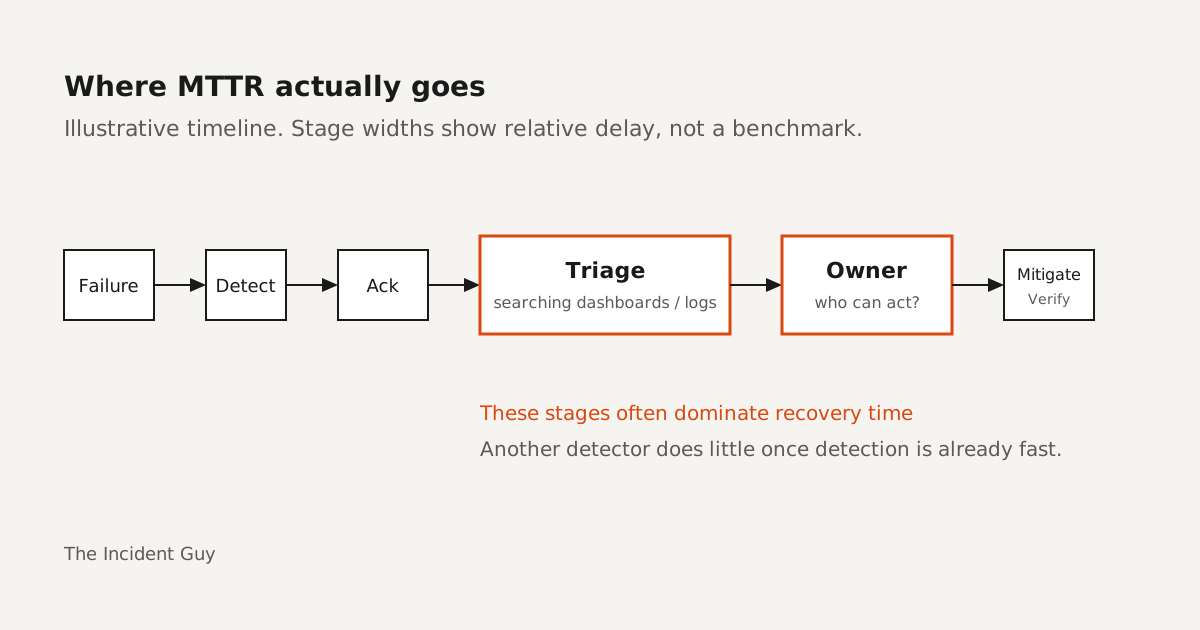
Where does MTTR actually go?
A production incident starts. PagerDuty fires. The engineer opens Grafana, then logs, then Kubernetes, then the deployment history. Someone asks whether anything changed. Another person is trying to find the service owner. Five alerts are firing, and none of them says whether customers can still complete the journey that matters.
Ten minutes pass. Nobody has changed production yet.
That is the MTTR problem I care about.
MTTR is used loosely in industry conversation. Teams may mean mean time to recover, mean time to restore, mean time to repair, or mean time to resolve. Those clocks can start and stop at different points: first customer impact, first alert, first acknowledgement, first mitigation, full root-cause closure. If your organisation has not written down the definition, the number is not comparable across teams, tools, or quarters.
In this article, MTTR means the time from customer impact to restored service, unless a team has defined something else. The practical work is the same either way: find where responders wait, search, escalate, and guess, then remove that delay.
How do you reduce MTTR? It usually improves when teams spend less time understanding impact, finding the right owner, forming a useful hypothesis, and executing a safe recovery. Better alert context, clear service ownership, tested runbooks, visible deployment history, and reliable rollback paths often matter more than increasing alert volume.
One short clarification for people who track DORA metrics: in 2023, DORA renamed and narrowed the delivery metric previously discussed as MTTR / time to restore. It is now failed deployment recovery time, focused on restoring service after a production change caused impairment. That is useful for delivery performance. This article is about incident recovery more broadly, including failures that are not caused by a deployment.
MTTR is a recovery problem first
Adding another alert is a common reaction after an incident. Sometimes it is the right reaction. It helps when detection itself was the bottleneck: the service was broken for a long time and nobody knew.
It helps far less when the team already detected the problem quickly and then spent the next forty minutes deciding what failed, who owns it, what changed, whether rollback is safe, which dependency is involved, and who can approve a mitigation. A second detector does not shorten that work.
I start from the incident timeline, not from the final average. Record when impact began, when the first useful signal arrived, when someone acknowledged it, when the correct owner joined, when the first credible hypothesis appeared, when mitigation started, and when customer-facing metrics recovered. That sequence shows where recovery time actually went.
Google’s incident metrics work cautions against using mean incident duration alone for operational decisions. Incident durations are often skewed. A single average can hide a long tail of messy recoveries, or make a lucky week look like a process win. Look at the distribution as well: median, p75, p90, and splits by severity, service, and incident type. Do not treat one mean as the whole story.
Break recovery time into stages
Teams use different names for the same work. The labels matter less than making the stages visible:
- Problem begins
- Detect
- Acknowledge
- Understand impact
- Get the right owner
- Form a hypothesis
- Mitigate
- Verify recovery
- Close the incident or continue investigation
Once those stages are visible, patterns appear. One illustrative example:
| Stage | Time spent |
|---|---|
| Detection | 2 min |
| Acknowledgement | 3 min |
| Triage | 22 min |
| Mitigation | 5 min |
In that example, another alert is unlikely to fix the 22-minute triage problem. The team already knows something is wrong. They are spending time reconstructing the customer story, chasing ownership, and deciding what is safe to change.
Measure time to mitigation separately
Stopping customer impact, finding root cause, and permanently fixing the underlying issue are different jobs. During an active incident, restoring service usually comes first.
Mitigation can look like a rollback, disabling a feature flag, shifting traffic, isolating a dependency, scaling capacity, failing over, or temporarily removing a bad integration. Root-cause work can continue after the service is stable. That separation keeps responders from treating a complete diagnosis as a prerequisite for every recovery action.
This is not an argument for reckless change. Prefer mitigations that are understood, controlled, and reversible where possible. If the rollback path is untested, the feature flag has side effects, or failover has never been exercised, treat that as an engineering gap discovered during the incident, not as proof that waiting for perfect certainty was the better plan.
Why does unclear ownership increase recovery time?
Nobody should have to search Slack history during an outage to discover who owns a production service.
Unclear ownership stretches every later stage. Responders lose minutes confirming the service owner, the on-call owner, the escalation path, dependent teams, and, when needed, the business owner who can accept a trade-off. Platform ownership for databases, networking, identity, and shared infrastructure needs the same clarity. A checkout failure that depends on an auth service and a payments dependency will bounce between teams until those boundaries are already written down.
Put ownership where responders already look: service catalogue entries, repository metadata, deployment metadata, dashboard titles, runbooks, and on-call schedules. Keep a named escalation path for customer-impact decisions. If ownership only lives in someone’s head, it will be missing at 2 AM.
Ambiguous ownership also increases the chance of duplicated work. Two teams debug the same symptom while a third waits for someone to admit the service is theirs. That is coordination cost, not recovery progress. Related reading: human error is not a root cause covers why vague ownership and weak controls keep showing up in post-incident reviews.
Alert on symptoms that matter to users
“CPU > 80%” can be useful telemetry. It does not automatically tell the responder that customers are affected. Compare that with checkout failure rate, request success rate, login failures, latency against an SLO, a message-processing backlog that breaks expected processing time, or the availability of a critical customer journey.
Google SRE’s practical alerting guidance and alerting on SLOs push teams toward signals that represent user pain and require human action. Page on conditions that need a person. Keep diagnostic metrics available without converting every saturation graph into a page.
Infrastructure metrics are not useless. CPU, memory, saturation, database connections, disk, queues, and similar signals are essential for diagnosis. Some of them should page when they predict imminent failure and there is a known action. The test is simple: does a human need to act now, and does the alert help them start that action?
Trim alerts that never change behaviour. If nobody pages on a signal, or every page becomes a mute, rewrite or remove it. Alert fatigue is not a personality problem. It is what happens when the paging channel stops representing customer risk.
What should an incident alert contain?
A useful page should help the responder answer basic questions without assembling context by hand:
- What service is affected?
- What user journey is affected?
- When did it start?
- Which environment?
- Which region or cluster?
- What changed recently?
- Which dashboard should I open?
- Which logs or traces should I query?
- Who owns the service?
- Is there a runbook?
- Is there a known rollback or mitigation?
- Are dependencies already showing problems?
If responders spend the first ten minutes collecting those answers from five tools, the alert system is incomplete. Deep-link the page to the relevant dashboard, logs, traces, deployment history, service catalogue entry, runbook, recent changes, and dependency map. The goal is not prettier notifications. The goal is a shorter path from page to first useful action.
Recent changes should be visible during incidents
Google SRE monitoring guidance recommends watching production changes because they often provide immediate incident context. Application deployments, configuration changes, feature flags, infrastructure changes, database changes, and dependency releases all belong on the same mental map as the failing metric.
A deployment marker on a latency or error graph is frequently more useful than asking people to search CI/CD history while the pager is still ringing. Make change visibility part of the default incident view: what shipped, who shipped it, when it started rolling out, and how to reverse it.
Not every incident is caused by a change. Plenty of outages come from capacity, dependency failure, certificate expiry, or data growth. Still, “what changed?” is one of the highest-value early questions. If answering it takes fifteen minutes, you have found a process bug.
Reduce context switching
A common incident path looks like this: alert system, dashboard, logs, tracing, Kubernetes or cloud console, deployment tool, Slack, documentation, service catalogue. Each system can be useful. The cost appears when every incident forces an engineer to rebuild the story from scratch across all of them.
Reduce that tax with deep links, a standard dashboard structure, consistent service names, correlation IDs, trace IDs, deployment markers, incident templates, service metadata, and a central incident timeline. The point is not to force one vendor. The point is to stop making responders reconstruct basic facts under pressure.
Consistent naming sounds boring until you watch two teams argue about whether `checkout-api`, `CheckoutService`, and `payments-checkout` are the same thing while customers are stuck. Naming is operational infrastructure.
How do runbooks reduce recovery time?
A runbook written as an essay fails during an incident. Under pressure, responders need scannable recovery guidance:
- Symptoms and how they appear to customers
- Confirmation checks before acting
- Immediate safe actions
- Rollback and failover steps
- Known dependencies
- Verification steps after mitigation
- Escalation path
- Dangerous actions to avoid
- Required access and where to get it
Keep runbooks close to the services they describe. Link them from alerts and dashboards. Review them after incidents and during drills. A document that has never been used under time pressure is still a draft, even if the formatting looks finished.
Make rollback boring
Rollback should be known, tested, fast, correctly permissioned, observable, and reversible. If it is heroic, it is not ready.
Common sources of delay are familiar: nobody knows the previous version, a database migration cannot be reversed cleanly, only one engineer has permissions, the rollback document is stale, configuration changed separately from the application, or responders are unsure whether rolling back will make things worse.
Design deployments with recovery in mind before the change reaches production. Progressive delivery, health checks, feature flags, and reversible schema strategies reduce the number of incidents where the only options are “stare longer” or “push a hurried fix.” If your team cannot state the rollback path during the change review, the review is incomplete.
Separate mitigation from diagnosis
Responders sometimes lose time trying to prove exactly why something failed before reducing customer impact. That instinct is understandable. It can also keep the blast radius open longer than necessary.
Illustrative example: a new release coincides with checkout failures. The team may not yet know whether the bug is application code, a schema assumption, or an upstream API interaction. If a safe rollback exists and restores checkout, mitigation can happen before the complete root-cause investigation. Label that as an illustrative pattern, not a universal rule. Some failures need targeted diagnosis first because the obvious rollback is unsafe or incomplete.
A useful incident habit is to say the distinction out loud: “We are mitigating now. We are still investigating why.” That keeps stakeholders from treating unfinished diagnosis as unfinished recovery.
Assign incident roles when incidents become large
Small incidents do not need a ceremony. Large ones do need coordination. Google’s incident management guidance and the SRE workbook chapter on incident response describe simple roles such as an incident commander, technical responders, communications, and subject-matter experts.
Use roles when multiple teams are involved, customer communication is active, or several people are debugging in parallel without a shared plan. Five engineers investigating independently can generate a lot of activity without shortening recovery. Someone has to keep the working theory, the next action, and the communication cadence visible.
For a contained single-service issue with a clear owner and a known mitigation, keep the process light. Process should match blast radius.
Communication affects MTTR too
Constant requests such as “Any update?”, “Do we know the cause?”, and “When will this be fixed?” interrupt the people doing the recovery work. During significant incidents, separate technical response from stakeholder updates.
A predictable communication rhythm helps: a short status on a fixed interval, a named channel for updates, and one person responsible for external communication. The technical channel stays focused on hypothesis, action, and verification. Stakeholders get timed updates instead of ad-hoc pings.
Poor communication also lengthens incidents indirectly. If product, support, and leadership cannot see impact and next steps, they escalate through private messages and meetings. That creates more context switching for responders. Clear status reduces that load.
Practice recovery paths
A recovery plan is useful only if it works when required. Restore testing, failover testing, rollback drills, dependency-failure exercises, credential validation, game days, and disaster-recovery exercises exist to find the missing access, stale docs, and steps that only one person understands.
The goal is not theatre. If the exercise always succeeds because the scenario was softened, the team learns little. Use realistic permissions, realistic dashboards, and realistic time pressure where it is safe to do so. Capture the delays the same way you would capture them in a real incident: access, ownership, unclear runbook steps, missing telemetry, slow approvals.
I also treat credential and permission checks as recovery work. Discovering during an outage that the on-call role cannot roll back, open the right dashboard, or access the database console is a self-inflicted extension of MTTR.
Automate waiting, not judgement
Automation helps when it removes waiting. Good examples include gathering diagnostic context, attaching recent deployments, querying health endpoints, fetching relevant logs, restarting a known-safe stateless component where policy allows, running a rollback workflow, shifting traffic, purging a cache, or toggling a feature flag.
Be careful with destructive remediation. Automation should expose what it did, what it changed, and how to reverse it. If responders cannot inspect the action, they will hesitate, override it, or fight it. Hesitation is still MTTR.
This is also where tooling decisions get honest. When I work on incident tooling, including through Vigiles, the useful parts are rarely another alert stream. The useful parts are faster context, clearer ownership, and safer recovery actions. What AIOps can and cannot do covers the same boundary from another angle: correlation can help, autonomous recovery without bounds can make incidents larger.
How should teams review incident timelines?
Hypothetical architectures are a weak guide. Your last incidents are a better one.
Take the last five to ten meaningful production incidents and reconstruct:
- Impact start
- Detection
- Acknowledgement
- Incident declaration
- Correct owner engaged
- First useful hypothesis
- First mitigation
- Recovery
- Verification
Then ask where the team spent time. Categorise delay into buckets such as detection, ownership, access, diagnosis, communication, approval, rollback, missing telemetry, stale runbook, or dependency investigation. Recurring buckets become engineering work. One-off chaos may still teach something, but repeated ownership searches or rollback uncertainty are backlog items, not bad luck.
This review method also protects you from vanity averages. If mean MTTR looks fine while p90 incidents are still messy, the distribution is telling you where to invest. Microsoft’s Well-Architected incident response guidance and Atlassian’s overview of common incident metrics are useful references for defining the clocks your organisation wants to track. Keep the definitions local and explicit.
What I would check before buying another monitoring tool
Before adding another monitoring, observability, or incident platform, ask:
- Are incidents detected too late?
- Are current alerts actionable?
- Can responders see customer impact?
- Can they see recent changes?
- Is service ownership clear?
- Can they roll back safely?
- Are logs, metrics, and traces connected well enough to investigate?
- Do past incidents show where recovery time is being lost?
This is not an argument against buying tools. It is an argument for identifying the bottleneck first. If detection is already fast and ownership is unclear, another metrics product will not fix the ownership map. If rollback is untested, a prettier dashboard will not make recovery safe. Buy for the stage that is actually slow.
FinOps pressure can also shape these decisions. Cutting observability retention or standby capacity to save money can quietly lengthen future incidents. FinOps decisions that keep reliability intact covers that trade-off directly.
A practical MTTR reduction checklist
Use this as a working review list, not a scoreboard:
Checklist
0 of 14 checks completed
Start with the last five incidents
Take the last five production incidents. Put the timeline on one page. Mark where the team was waiting, searching, asking for access, looking for an owner, proving a hypothesis, or trying to work out how to restore service.
That is where the next MTTR improvement is likely hiding.
If your team is dealing with slow incident recovery, noisy alerting, unclear ownership, or unreliable recovery paths, I work with engineering teams on incident management and SRE maturity. You can reach me through the contact section or read more about the work.
Questions teams ask about MTTR
What does MTTR mean?
MTTR is used for mean time to recover, restore, repair, or resolve. Teams must define when the clock starts and stops. In this article it usually means time from customer impact to restored service.
How do you reduce MTTR?
Reduce time spent understanding impact, finding owners, forming a useful hypothesis, and executing safe recovery. Improve alert context, ownership, runbooks, change visibility, and rollback before adding more alerts.
Does adding more alerts reduce MTTR?
Only when detection is the bottleneck. If the team already detects quickly and then spends a long time on triage, ownership, or mitigation, more alerts usually add noise instead of faster recovery.
What is the difference between MTTR and MTTA?
MTTA usually means mean time to acknowledge: how long until a human accepts the page. MTTR covers recovery to restored service. Both can be useful, but neither replaces a full incident timeline.
Should MTTR include root cause analysis?
Usually no for active recovery. Measure time to mitigation and restored service separately from the later work of finding and permanently fixing root causes.
What metrics should I track alongside MTTR?
Track stage timings, distribution values such as median and p90, and splits by severity, service, and incident type. Review recurring delay categories from real incidents.
Sources and further reading
- Google SRE: Incident Management Guide
- Google SRE Workbook: Incident Response
- Google SRE Book: Practical Alerting
- Google SRE Workbook: Alerting on SLOs
- Google SRE Workbook: Monitoring Distributed Systems
- Google SRE: Incident Metrics in SRE
- DORA: A history of DORA’s software delivery metrics
- Microsoft Azure Well-Architected: Incident response
- Atlassian: Common incident management metrics